
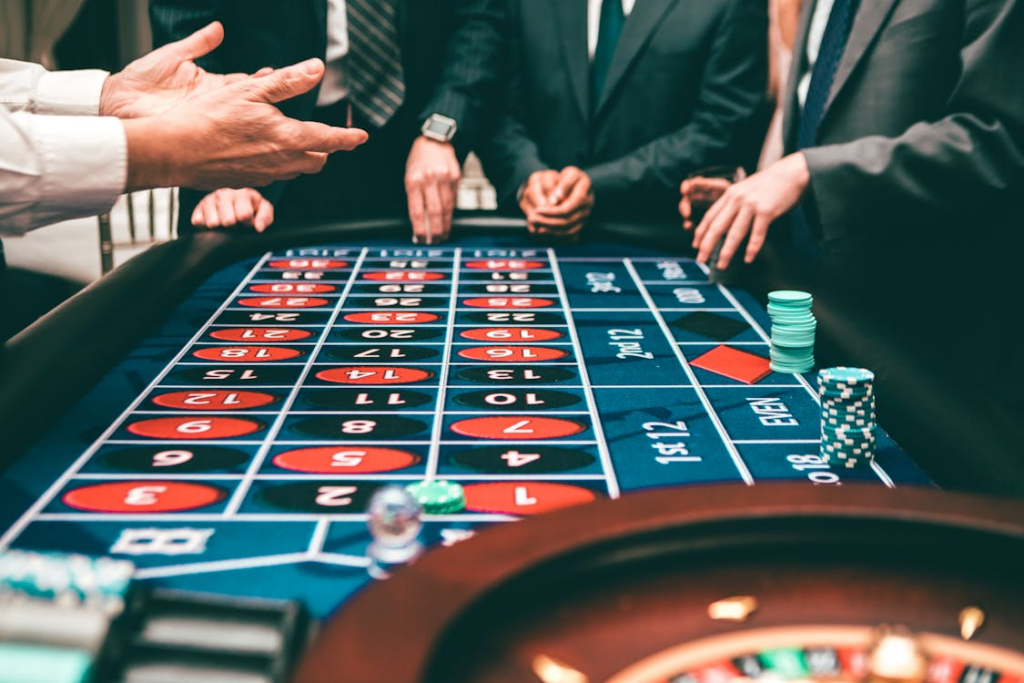
Want to make better in-game decisions?
Mathematical probability isn’t just for statisticians or seasoned high rollers at Vegas casinos. The same strategies and probabilities that govern a roulette wheel apply directly to how you should approach video games, board games, and all the decisions you make when outcomes are uncertain.
Here’s the thing:
The majority of players make decisions based on terrible probability logic. They chase after their losses, overvalue winning streaks, and completely misunderstand how random chance works.
The good news? By understanding how roulette numbers and probability logic work, you can radically improve your in-game decision making.
What you’re about to discover:
- The Truth Behind Roulette Number Probability
- Why Players Get Probability Wrong
- Applying Wheel Logic to Gaming Decisions
- Risk vs Reward: Making Smarter Choices
The Truth Behind Roulette Number Probability
Let’s get this out of the way first.
Every single number on a roulette wheel has an equal probability of being hit on any given spin. Whether you’re tracking roulette numbers or watching for patterns… The wheel doesn’t care what happened in the past.
In European roulette, every number has a 1-in-37 chance of hitting. American wheels increase that to 1-in-38 because of the additional double zero.
That’s it. No lucky numbers. No streaks. It’s a cold hard number.
The house edge for American roulette comes in at 5.26% when you do the probability calculations. European roulette cuts that to 2.70% with the single zero. These numbers never change regardless of recent outcomes.
So why do players continue to believe certain numbers come up more frequently?
Why Players Get Probability Wrong
This happened not too long ago back in 1913.
The ball landed on black 26 times in a row at the Monte Carlo Casino. The gamblers in attendance lost millions betting on red, convinced it was “due” to come up next.
It wasn’t.
This cognitive bias goes by the name gambler’s fallacy, and it doesn’t just affect casino gamblers.
The science shows this bias exists anytime decisions are made. A study from Carnegie Mellon researchers found that umpires were 1.3% less likely to call a strikeout if the previous two pitches were also strikes. The gambler’s fallacy even impacts loan officers and asylum judges making life or death decisions.
The human brain is hardwired to look for patterns. Even when none exist.
Here’s the problem:
If you bring this flawed thinking to gaming, you’ll make poor decisions over and over. You’ll expect the dice to balance out. You’ll assume that after a dry spell the rare loot drop is coming. You’ll take unnecessary risks because you “feel due” for a win.
None of that is how probability works.
Applying Wheel Logic to Gaming Decisions
The question is: How do the underlying principles of roulette translate to gaming and better decision making?
The core tenets are actually quite simple when you know them. They apply to poker decisions, dice rolls in tabletop RPGs, or calculating hit percentages in tactical shooters.
Independent events remain independent. Just like a roulette wheel spin, every roll of the dice in your strategy game is starting with a fresh chance. Past losses don’t boost your chances of winning. A winning streak doesn’t mean you’re suddenly primed to lose.
Look at games like XCOM or Fire Emblem. A 90% chance to hit means just that. Not 100%. And missing three 90% shots in a row doesn’t mean the fourth one is more likely to connect.
The math is never wrong. Before you take a risky action, work out the real odds. In the board game Risk, attackers win each dice battle about 60% of the time when rolling 3 dice versus 2. Knowing that stops overconfident attackers and overly cautious defenders.
Understand house edges. Every game with random mechanics has built-in probabilities. Gacha games and loot boxes operate in precisely the same way as casino games. The developer always has an edge. Knowing that can ground your expectations.
Risk vs Reward: Making Smarter Choices
Civilization creator Sid Meier once famously said that a game is a series of interesting decisions. And interesting decisions always involve tradeoffs of risk and reward.
This holds whether you’re betting chips at a casino table or spending resources in a city building game. Every decision has potential upsides and potential downsides. The trick is accurately estimating both.
Here’s what separates good players from great ones:
Great players make decisions based on probability, not emotion. They evaluate the real risk, weigh the potential reward, and decide accordingly.
Bad decisions come from:
- Chasing losses after a losing streak
- Overconfidence during a winning streak
- Misunderstanding the meaning of random
- Letting frustration cloud judgment
The same psychological traps that drain your pockets at the roulette table sap your performance in competitive games.
Building Better Decision Habits
So how do you go about putting this into practice?
It starts with awareness. Just being aware that the gambler’s fallacy is real puts you way ahead of other players. But knowing isn’t enough. You need practical habits that help counter your instincts.
- Track your outcomes. Keep a mental or written log of your results over time. This helps you internalize that variance is normal. It prevents emotional overreactions to short term results. After 100 attempts, patterns that seem significant often disappear entirely.
- Set risk thresholds before you play. Decide in advance what level of risk you’re comfortable with. Roulette players who set loss limits prevent themselves from chasing their losses. Gamers can use the same approach with resources, attempts, or time spent.
- Accept variance. Random is random. Sometimes you’ll lose five 80% chances in a row. Sometimes you’ll hit three 5% critical strikes in a row. Both are completely normal outcomes.
- Question your instincts. When you feel like something is “due” to happen, stop and think. Ask yourself if that feeling is based on real probability or the gambler’s fallacy starting to set in.
Putting It All Together
The logic and math behind roulette probability applies to nearly every game that involves chance and risk. Whether you’re rolling dice, opening loot boxes, or deciding whether to push an attack in a strategy game… The math works the exact same.
The knowledge becomes especially powerful in competitive settings. Players with a strong understanding of probability make decisions based on expected value rather than gut feelings. They don’t tilt after a streak of bad luck. They don’t get overconfident after a string of good fortune.
Here’s what matters:
- Each random event is independent
- Past results don’t influence future events
- The odds don’t change based on recent results
- Emotion-based decisions almost always cost
Understanding these principles won’t make you a winner. Nothing can with random systems. But it will help you make consistently better decisions over time.
And in the long run? Better decisions will beat luck every single time.
That’s the real lesson from the roulette wheel. Not which numbers you should bet on, but how to think about probability itself.